SQL vs NoSQL Database Differences Explained with few Example DB
The 5 differences SQL vs NoSQL
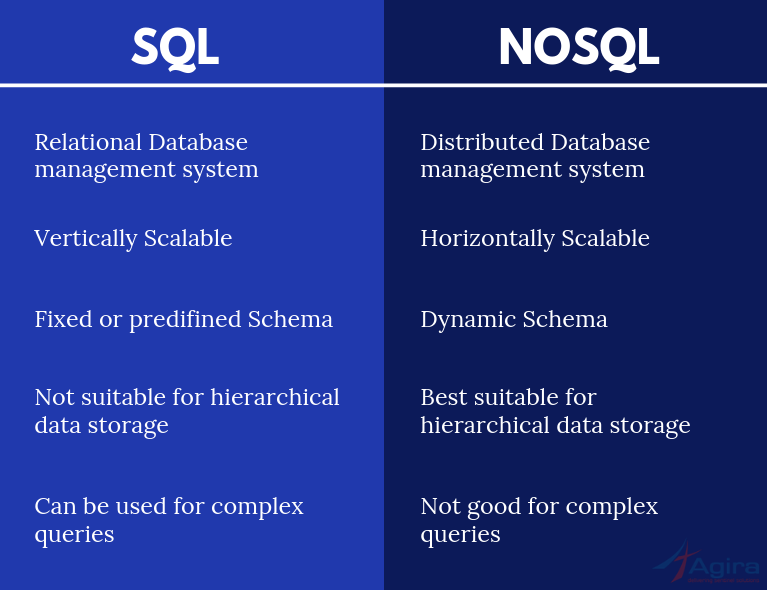
- What kind of data is a good fit for an SQL database?
- If your data is highly structured and associations among the program entities are clearly defined, conventional SQL based databases are the best fit.
2.Give a real world example.
- (for instance, if you are developing a point of sale system where you need to store customer orders and product records)
3.What kind of data is a good fit a NoSQL database?
- Choose NoSQL if you have or need: Semi-structured or Unstructured data / flexible schema. Limited pre-defined access paths and query patterns. No complex queries, stored procedures, or views.
4.Give a real world example.
5.Which type of database is best for hierarchical data storage?
- NoSQL :ongoDB and CouchDB offer solutions, but not built in functionality.
6.Which type of database is best for scalability?
- SQL
SQL ,NoSQL
- What does SQL stand for?
- Structured Query Language
2.What is a realational database?
- A relational database is a type of database that stores and provides access to data points that are related to one another. … The columns of the table hold attributes of the data, and each record usually has a value for each attribute, making it easy to establish the relationships among data points.
3.What type of structure does a relational database work with?
- Relational databases do not horizontally scale well across physical storage structures with multiple servers
4.What is a ‘schema’?
- A schema is a collection of database objects like tables, triggers, stored procedures, etc. A schema is connected with a user which is known as the schema owner. Database may have one or more schema
5.What is a NoSQL database?
- NoSQL databases (aka “not only SQL”) are non tabular, and store data differently than relational tables. NoSQL databases come in a variety of types based on their data model. The main types are document, key-value, wide-column, and graph.
6.How does it work?
- NoSQL databases can store relationship data—they just store it differently than relational databases do. … In fact, when compared with SQL databases, many find modeling relationship data in NoSQL databases to be easier than in SQL databases, because related data doesn’t have to be split between tables.
7.What is inside of a Mongo database?
- Image result for 7.What is inside of a Mongo database? MongoDB stores data records as documents (specifically BSON documents) which are gathered together in collections. A database stores one or more collections of documents.
8.Which is more flexible - SQL or MongoDB? and why.
- Data in MongoDB has a flexible schema. Collections do not enforce document structure by default. This flexibility gives you data-modeling choices to match your application and its performance requirements. … MongoDB provides the capability for schema validation during updates and insertions.
9.What is the disadvantage of a NoSQL database?
- Disadvantages. NoSQL databases don’t have the reliability functions which Relational Databases have (basically don’t support ACID). This also means that NoSQL databases offer consistency in performance and scalability